Why the Right Retaining Wall Can Save Your Desert Backyard
Backyard retaining wall ideas are everywhere online, but many showcase beautiful designs without addressing the engineering challenges that come with building on Arizona’s rocky desert slopes. A slope that looks manageable in spring can become a serious problem the moment monsoon rains hit. When water surges down a grade with nowhere to go, it carves through soil, undermines foundations, and turns a sloped yard into a liability. For homeowners dealing with runoff on rocky lots, understanding practical drainage solutions for rocky soil can make the difference between a wall that simply looks good and one that performs when storms arrive.
Desert slopes come with added complications that most general guides skip over. Caliche — the hard, calcium-rich layer common throughout western Arizona — makes excavation difficult and prevents water from draining naturally through the soil profile. Without proper drainage engineering built into a retaining wall system, hydrostatic pressure builds up behind the wall until something gives. This is why professionally designed erosion control retaining walls are especially important on sloped desert properties where soil movement, stormwater, and grade changes all interact.
Here are the most effective design options to consider based on your yard’s slope, soil, and goals:
- Segmental concrete block walls — interlocking, mortarless, and built to handle thermal expansion in extreme heat
- Natural stone and boulder walls — durable, heat-resistant, and visually grounded in the desert landscape
- Tiered terraced walls — distribute soil load across multiple levels instead of one tall wall; ideal for steep slopes
- Walls with integrated drainage — French drains, weep holes, and gravel backfill to manage monsoon runoff
- Built-in seating and feature walls — combine structural function with outdoor living elements like fire pits or lighting
- Living retaining walls — desert-hardy plantings like Lantana paired with tiered hardscape to slow erosion
Retaining walls in the Sonoran Desert aren’t just a design choice — they’re a structural investment that protects your property from erosion, slope failure, and water damage. The right design, materials, and drainage system make the difference between a wall that holds for decades and one that shifts after the first big storm, which is why the local retaining wall installation process in Lake Havasu should account for caliche, runoff patterns, wall height, and the loads above the slope.
Creative Retaining Wall Ideas for Sloped Lake Havasu Backyards
A sloped yard does not have to be wasted space. For homeowners comparing backyard retaining wall ideas, the best designs usually solve two problems at once: they create usable outdoor living space and control runoff before it can damage patios, pool decks, RV parking areas, or lower planting beds.
In Lake Havasu City, Golden Shores, and Parker, the most effective retaining wall ideas are shaped by the realities of desert lots. Homes built into rocky hillsides often need tiered walls to create flat patios. Lake-view properties may use curved walls to follow the contour of a slope without blocking sightlines. Backyards with elevated pool decks may need grade retention behind seating areas, paver patios, or outdoor kitchens.
Visual Retaining Wall Ideas for Desert Yards
Here are practical design directions that fit the way local homeowners actually use sloped desert properties:
- Curved retaining walls that follow natural hillside contours and soften the look of a steep grade
- Raised planter retaining walls filled with desert-hardy plants like Lantana or Totem Pole cactus
- Retaining wall seating with stone caps at bench height for patios, fire pits, and conversation areas
- Retaining walls with lighting to illuminate steps, walkways, and wall texture after sunset
- Pool-area retaining walls that stabilize grade changes around elevated pool decks
- Retaining walls with pavers to connect patios, walkways, and outdoor kitchen zones
- Boulder retaining walls that blend into rocky hillsides and match the surrounding desert terrain
- Tiered retaining wall ideas that break a steep slope into smaller, safer, more usable levels
These design-first options help the wall feel like part of the landscape instead of a purely structural barrier. Choosing materials, colors, and layouts that complement the surrounding desert landscape helps retaining walls look intentional rather than purely functional. For homeowners planning a larger transformation, River Palm Landscaping’s backyard design guidance shows how hardscape, shade, lighting, and planting zones can work together in extreme heat.
Tiered Retaining Wall Ideas for Steep Desert Slopes
Tiering a slope creates flat, manageable shelves that are easier to plant, irrigate, and maintain. Rather than trying to grow plants on a steep incline where water washes away topsoil and nutrients, terraced planters hold soil and moisture in place.
Many homes built into the hills overlooking Lake Havasu often benefit from tiered retaining walls that create usable patios while controlling runoff. RV parking pads can also require smaller retaining walls where the driveway grade changes sharply from the street to the side yard. These localized slope problems are exactly where good design and proper engineering need to work together.
Integrated Seating, Privacy, and Functional Features
A retaining wall can serve as more than a structural barrier; it can become a functional destination in your yard. When designed with a flat, stone-capped top at a height of 18 to 20 inches, a retaining wall can double as built-in bench seating for guests.
Many homeowners also combine a retaining wall fence with a lower structural wall to improve privacy while maximizing usable backyard space. This is common near pool decks, side yards, and elevated patios where grade retention and screening both matter.
These walls can be seamlessly integrated with other outdoor elements, such as:
- Fire pit surrounds: Curved retaining walls can wrap around a custom fire pit, creating a cozy, wind-protected conversation area.
- Outdoor kitchen backsplashes: A retaining wall can serve as the structural backbone for an outdoor grill, sink, and prep station.
- Low-voltage lighting: LED fixtures under stone caps or within the wall face improve walkway safety and highlight stone texture at night.
- Paver patio transitions: Retaining walls can define elevation changes between patios, steps, and walkways without making the space feel chopped up.
For more complete design inspiration, homeowners can explore River Palm Landscaping’s patios and outdoor kitchens and desert landscaping services to see how retaining walls fit into broader outdoor living plans.
Choosing Materials for Long-Lasting Desert Retaining Walls
When selecting materials for a retaining wall in western Arizona, aesthetic appeal is only half of the equation. The primary challenge is finding materials that can withstand intense western sun exposure, handle extreme thermal expansion, and remain structurally sound when anchored into caliche-heavy soils.
According to the University of Arizona Cooperative Extension guidelines on managing desert soils, desert earth behaves differently than soft, organic soils found in other regions. It is highly alkaline, often compacted, and prone to shifting during flash floods. Cheap lumber or poorly mixed concrete will quickly degrade, crack, or bow under these conditions. Building a wall that stands the test of time requires selecting materials specifically engineered to handle high thermal mass and intense heat. For more details on structural durability, homeowners can read about how erosion control retaining walls protect sloped desert properties.
Segmental Concrete Blocks
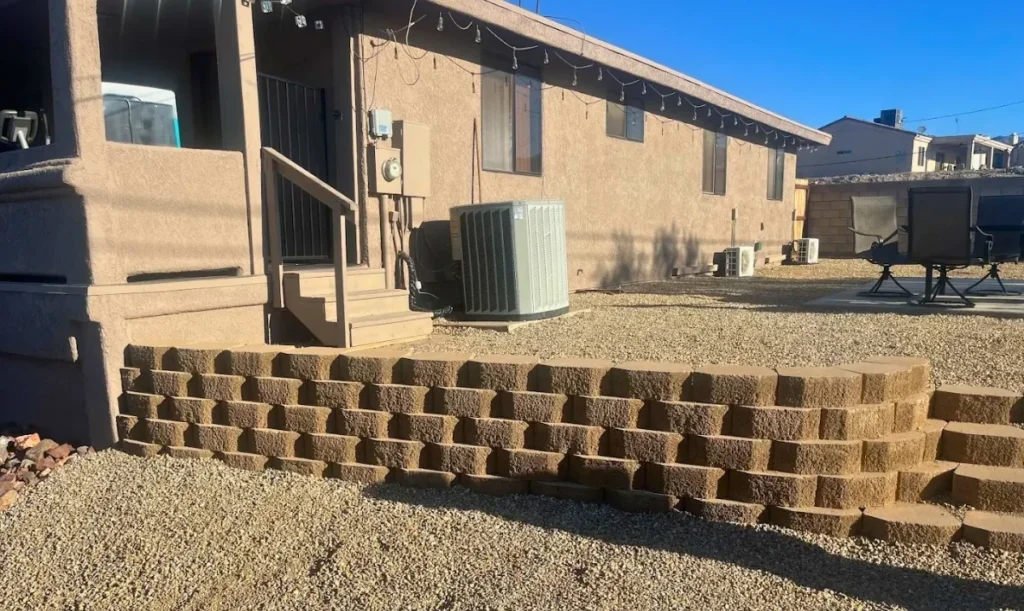
Segmental concrete blocks are the industry standard for modern desert hardscaping. These interlocking, dry-stacked blocks do not require mortar, which is a major advantage in Lake Havasu City where summer temperatures regularly exceed 110°F.
Mortared joints are highly susceptible to cracking due to thermal expansion and contraction. When the sun beats down on a mortared wall, the materials expand at different rates, leading to hairline fractures that eventually compromise the wall’s integrity. Segmental blocks, however, are designed to shift slightly without losing their structural connection. The interlocking design allows the wall to flex naturally with minor soil movements and thermal changes. Additionally, these blocks feature built-in setbacks, or batter, meaning they automatically lean slightly back into the hill as they are stacked, using gravity to resist the lateral pressure of the soil.
Natural Stone and Boulders
For homeowners seeking a more organic look, natural stone and boulder walls provide unmatched durability and timeless appeal. Using local granite, basalt, or fieldstone helps the structure blend into the surrounding desert terrain.
Natural stone has exceptional heat resistance and does not degrade under intense UV radiation. When constructing boulder walls, massive rocks are positioned using heavy machinery, with approximately one-third of each boulder buried below grade to anchor the system. This weight and mass make boulder walls highly effective at holding back heavy slopes. For visual retaining wall ideas that highlight these natural textures, homeowners can browse southwestern retaining wall landscape examples to see how dry-stacked stone can turn a functional barrier into a desert-style focal point.
Structural and Drainage Engineering on Desert Slopes
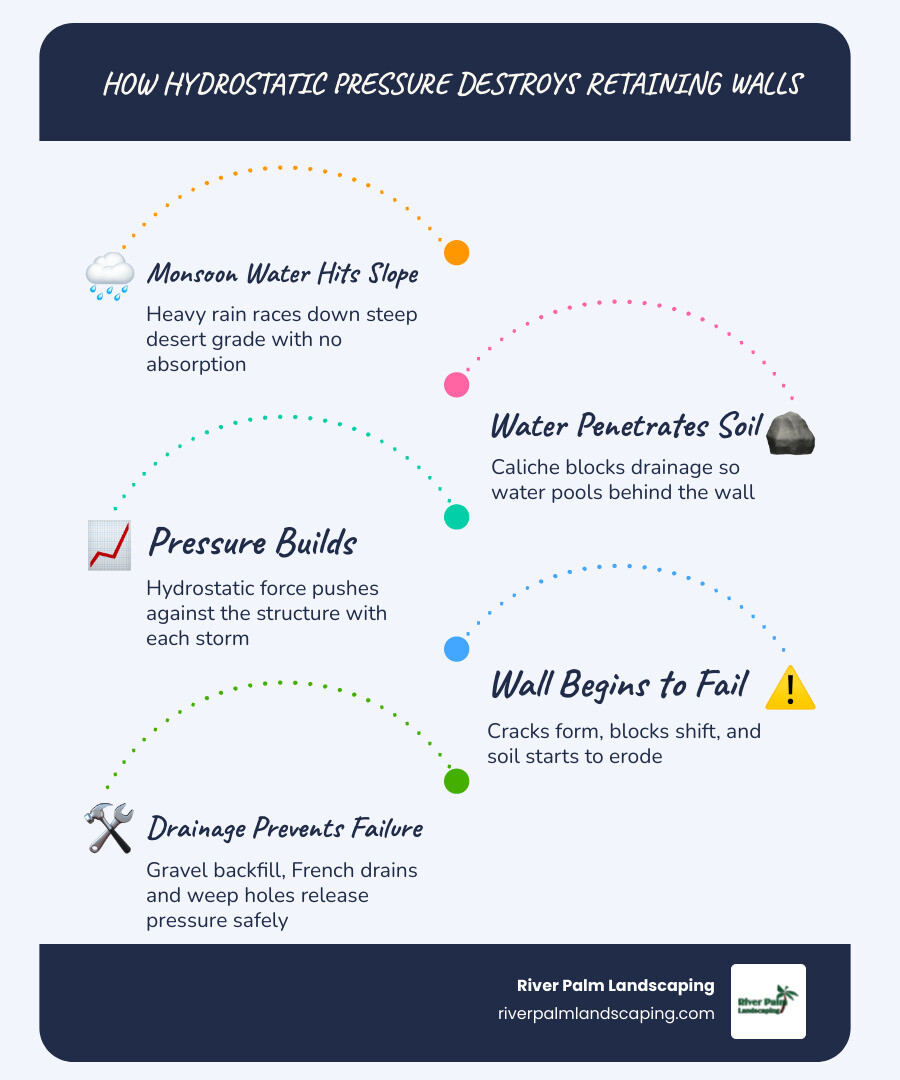
The number one cause of retaining wall failure is not a lack of structural strength in the face materials; it is poor water management. When a heavy rainstorm hits the Lake Havasu region, water runs off compacted desert soil rapidly. If a retaining wall stands in its path without a way for water to escape, that water pools behind the structure.
This accumulated water creates hydrostatic pressure. Saturated soil weighs significantly more than dry soil, and the building pressure will eventually push the wall forward, causing it to bow, slide, or collapse entirely. Proper engineering requires a dedicated system to collect, redirect, and release this water safely. Homeowners planning a sloped project can review professional retaining wall ideas for sloped backyards to see how design inspiration and drainage planning often overlap.
Managing Hydrostatic Pressure
To prevent water from building up behind a wall, a professional installation must include three critical drainage components:
- Clean gravel backfill: Native desert clay or caliche should never be packed directly against the back of a retaining wall. Instead, a column of clean, crushed gravel at least 12 inches wide must be placed behind the blocks. Gravel allows water to flow downward quickly instead of pooling in the soil.
- Geotextile filter fabric: To prevent fine desert sand and silt from washing into the gravel backfill and clogging the system, a layer of heavy-duty filter fabric must separate the native soil from the drainage gravel.
- Perforated drain pipes and weep holes: At the base of the gravel backfill, a perforated drain pipe, often called a French drain, must be installed to collect water and channel it away to a safe discharge zone. For solid-face walls, weep holes should be placed every 6 to 8 feet along the bottom course to allow trapped water to escape immediately.
Engineering for Driveway Retaining Walls and Tiered Walls
When dealing with steep desert hillsides, building a single, towering retaining wall is rarely the safest or most cost-effective option. Instead, a series of shorter, tiered walls is often preferred. However, tiers cannot simply be stacked closely together like stairs.
To ensure structural independence, builders must follow the 2:1 setback rule. This engineering principle dictates that the upper tier must be set back from the lower tier by a distance equal to at least twice the height of the lower wall. For example, if the bottom wall is 3 feet tall, the second wall must start at least 6 feet behind it. If the walls are built too close together, the weight of the upper wall and its soil, known as a surcharge load, will bear down directly on the lower wall, causing it to fail.
A driveway retaining wall often requires additional engineering because parked vehicles create significant surcharge pressure above the wall. The same is true for walls supporting pool decks, elevated patios, or homes carved into rocky hillsides where the load above the wall is more than simple landscape soil.
Evaluating Professional Installation vs. DIY Risks
While small garden borders under a foot tall can sometimes be tackled over a weekend, building a structural retaining wall on a desert slope is a highly complex task. The physical reality of working with heavy materials, paired with the engineering precision required to prevent wall collapse, makes professional installation a necessity for most residential properties.
Understanding the mechanics of soil pressure, compaction, and drainage is critical to a project’s success. Homeowners looking to understand the scope of these projects can read about professional retaining wall installation in Lake Havasu to learn why specialized equipment and experienced crews are required to build walls that last.
Local Building Codes and Permitting
In Lake Havasu City, Golden Shores, and Parker, building codes are enforced to protect properties from slope failure and structural hazards. Generally, any retaining wall that exceeds 4 feet in height, measured from the bottom of the buried footing to the top of the wall, requires a building permit and stamped engineering plans from a licensed civil engineer.
Additionally, if a wall supports a surcharge load, such as a driveway, swimming pool, nearby structure, or slope steeper than a 2:1 grade above it, it will require professional engineering regardless of its height. A driveway retaining wall is one of the most common examples because vehicle weight adds pressure the wall must be designed to resist. Attempting to build a tall wall without proper permits can result in costly fines, code violations, and the potential requirement to tear down the unpermitted structure.
The Danger of Caliche and Rocky Soil Excavation
Excavating a trench for a retaining wall base in western Arizona is rarely a simple shovel-and-dirt job. Homeowners frequently run into caliche, a concrete-like layer of soil cemented by calcium carbonate.
Breaking through caliche to establish a level, compacted gravel footing requires heavy commercial equipment, such as jackhammers, skid steers, and mini-excavators. Without proper base compaction and depth, a retaining wall will quickly settle unevenly, causing the entire structure to lean and crack. Professional contractors have the machinery and experience necessary to handle difficult grading, break through rocky obstructions, and establish a level foundation below the frost and erosion lines.
Frequently Asked Questions About Desert Retaining Walls
What are the best backyard retaining wall ideas for a sloped desert yard?
The best backyard retaining wall ideas for Lake Havasu-area yards usually combine visual design with drainage control. Curved boulder walls, tiered planters, retaining wall seating, pool-area walls, and retaining walls with lighting are all strong options because they create usable space while helping manage runoff on rocky slopes.
Do I need a permit for a retaining wall in Lake Havasu City?
Yes, if the wall is over 4 feet tall, or if it supports a surcharge load such as a slope, driveway, or nearby structure, you must obtain a building permit. This process requires submitting engineered plans to ensure the wall is designed safely for soil and drainage conditions.
What is the best material for a retaining wall in extreme heat?
Segmental concrete blocks and natural stone are the best choices for desert climates. Unlike wood, which rots and warps, or mortared brick, which cracks under thermal expansion, these materials have high thermal mass, resist intense UV exposure, and handle shifting soils without structural failure.
Can I add a fence on top of a retaining wall?
A retaining wall fence can improve privacy around elevated patios, pool areas, and side yards, but it must be designed carefully. Fence posts add wind load and leverage to the wall, so the wall and fence should be engineered together instead of attaching a fence after the wall is built.
How do tiered retaining walls prevent soil erosion during monsoons?
Tiered walls act as speed bumps for rainwater. Instead of allowing water to rush down a steep slope and wash away soil, tiers break up the elevation change. This slows water velocity, allows some moisture to absorb into flat planting terraces, and channels the remaining runoff safely through integrated drainage systems.
Conclusion
A well-engineered retaining wall is one of the most important investments you can make to protect and beautify a sloped desert property. The strongest retaining wall ideas for Lake Havasu-area homes combine practical engineering with outdoor living design, including curved walls, tiered terraces, built-in seating, and integrated drainage.
Whether you’re exploring simple backyard retaining wall ideas or planning a complete slope transformation, choosing the right design, materials, and drainage system will help your investment perform for decades in Arizona’s desert climate.
If your property in Lake Havasu City, Golden Shores, or Parker, AZ is facing erosion risks, or if you want to reclaim unusable sloped land, contact the local experts at River Palm Landscaping. As a licensed, experienced contractor specializing in desert-hardy hardscaping, the team will design and construct a custom retaining wall built to withstand extreme heat, rocky soils, and heavy monsoon seasons.
Protect your property and elevate your outdoor living space by scheduling a professional consultation for your erosion control retaining walls project today.