Why Rocky Soil Makes Drainage a Real Problem in Lake Havasu City
Drainage solutions for rocky soil are something every homeowner in Lake Havasu City, Golden Shores, and Parker, AZ eventually needs — often after the first monsoon season exposes exactly where water is winning the battle against their yard.
Here are the most effective professional drainage solutions for rocky desert soil:
- French drains – Perforated pipe surrounded by angular crushed rock and geotextile fabric, installed in a trench sloped at 1-2% to redirect water away from foundations
- Dry wells and vertical infiltration pits – Gravel-filled shafts drilled 3-5 feet deep to bypass caliche hardpan and move water into permeable soil below
- Dry creek beds – Rock-lined channels using 1.5-3 inch river rock to carry monsoon runoff across the yard in a controlled, natural-looking path
- Rock-lined swales – Shallow graded channels with 3:1 side slopes that slow and spread surface water before it can pool or erode
- Riprap and rock terracing – Larger stone and structural armoring on slopes to prevent erosion and stabilize soil during heavy runoff events
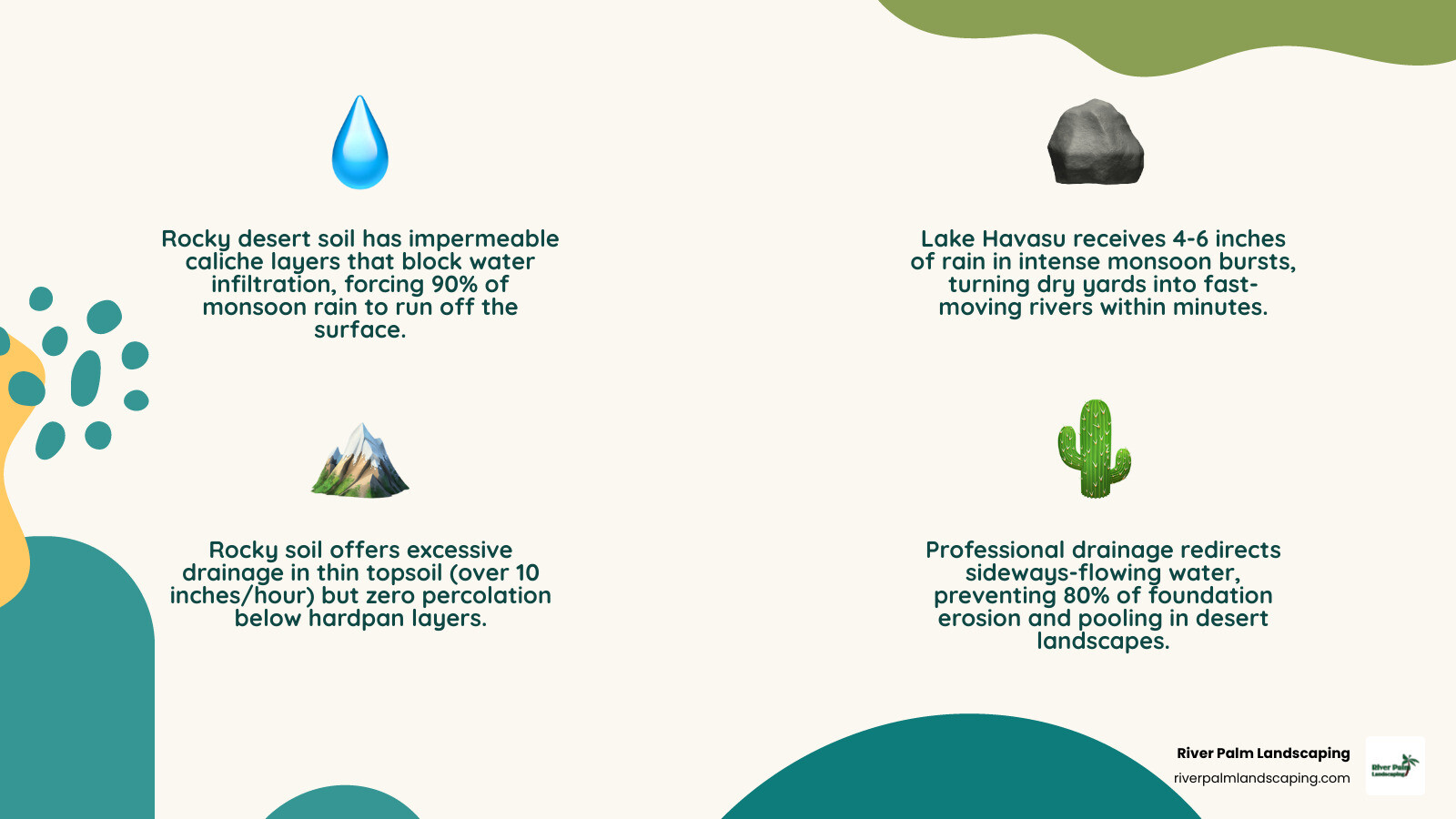
Rocky soil in the Sonoran Desert region behaves very differently from clay or sandy soil found elsewhere. The problem here is not just that rock is hard to dig through — it’s that impermeable bedrock and dense caliche layers force water to travel sideways across the surface rather than soaking in. During a monsoon storm, that means fast-moving runoff that scours soil, undercuts foundations, and floods low spots before it has anywhere to go.
Unlike clay soil, which drains slowly but does eventually absorb water, or sandy soil, which drains freely, rocky desert soil is often classified as either excessively drained in the thin top layer or completely blocked once water hits a hardpan layer underneath. Managing that reality takes professional assessment, the right materials, and installation that accounts for your specific site conditions — not a generic fix from a hardware store.
The good news: when drainage infrastructure is designed correctly for this climate, it can handle even the heaviest monsoon events while blending naturally into a desert landscape.
Professional Drainage Solutions for Rocky Soil
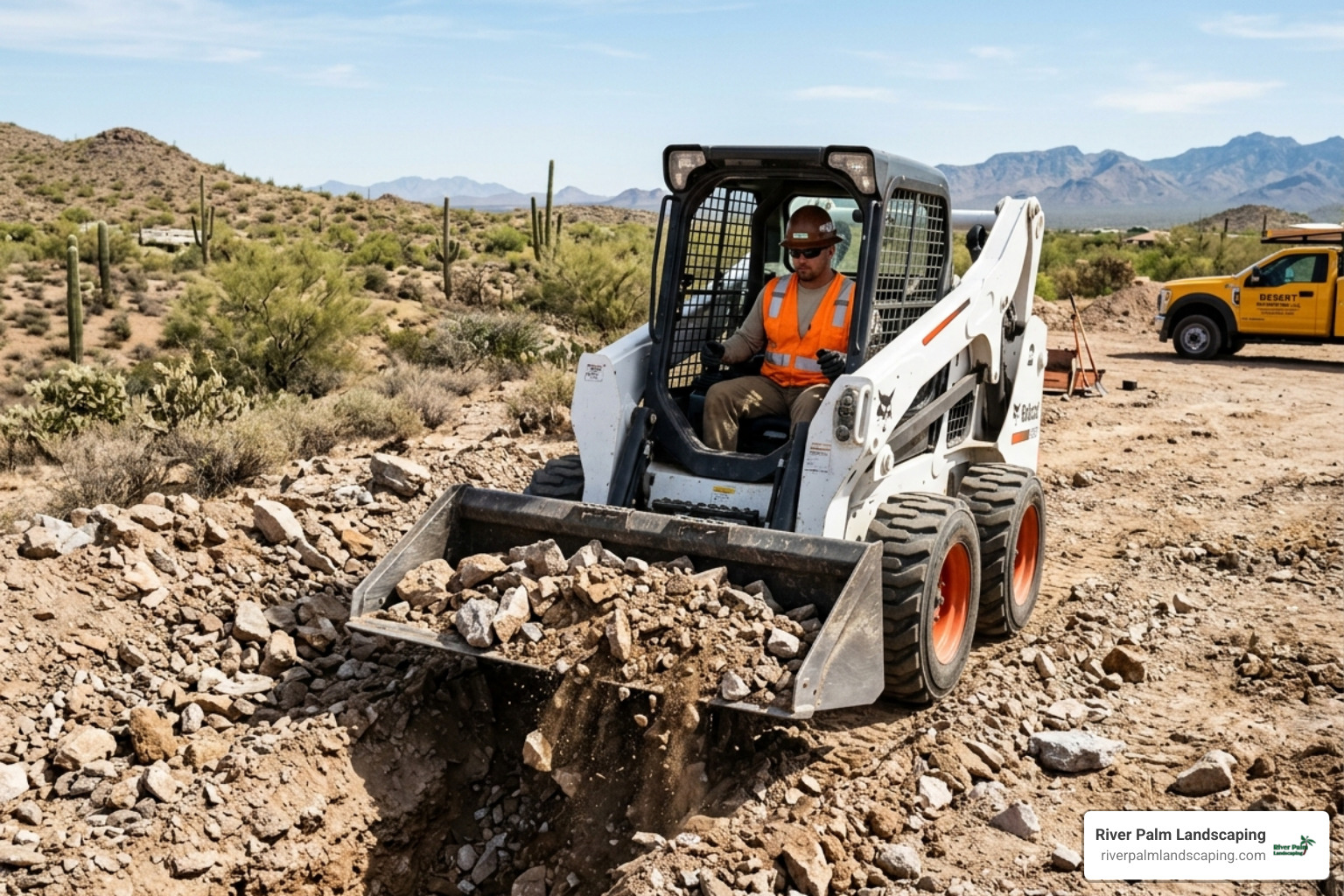
In the desert, a yard that looks dry 360 days a year can become a river in minutes. When dealing with drainage solutions for rocky soil, the first step for a professional contractor isn’t digging—it’s assessment. Because our local terrain is often a mix of loose surface rock and impenetrable caliche, water doesn’t follow the “standard” rules of infiltration.
A professional site assessment involves a detailed slope analysis to identify where water naturally congregates. In Lake Havasu, this often means looking at how runoff from the surrounding rocky hills or neighboring “shelf” lots impacts a property. Professionals use percolation tests to determine the soil’s actual absorption rate. In a healthy landscape, water should drain from a test hole within 24 hours; however, in many local yards, water may sit for days if it hits a caliche layer just inches below the surface.
Understanding how to improve drainage on rock outcrop sites requires a “surgical” approach to excavation. Since the rock itself has significantly lower permeability than standard soil, it leads to rapid surface runoff. Professionals must calculate the contributing area—such as the square footage of a roof or a large sloped driveway—to size the drainage system correctly. For instance, in areas with low infiltration rates (common in our 0.25 inches per hour soil), an infiltration trench might need a top area that is roughly 27% of the total contributing roof or driveway area to handle heavy storms.
| Desert Soil Type | Infiltration Rate | Common Drainage Challenge |
|---|---|---|
| Sandy/Loose Rock | High (1.0+ in/hr) | Erosion and soil scouring |
| Mixed Rocky Loam | Moderate (0.5 in/hr) | Occasional pooling |
| Caliche/Hardpan | Very Low (<0.1 in/hr) | Severe flooding; standing water |
Subsurface Infrastructure: French Drains and Dry Wells
When surface water management isn’t enough, subsurface infrastructure becomes the primary line of defense. These systems are designed to capture water before it can saturate the soil near a foundation and whisk it away to a safer discharge point.
According to technical solutions to soil problems III. drainage, subsurface systems are essential when dealing with “excessively drained” rocky topsoil that sits over an impermeable layer. Without a clear exit path, hydrostatic pressure can build up against basement or retaining walls, leading to structural cracks or moisture seepage into crawl spaces.
Subsurface French drains as drainage solutions for rocky soil
A professional French drain is more than just a “ditch with a pipe.” In the rocky terrain of Lake Havasu and Parker, the choice of backfill is critical. Professionals typically use 7/8-inch angular crushed rock rather than rounded river rock for the functional part of the drain. Why? Angular rock pieces lock together, providing better stability for the perforated pipe and maintaining consistent void spaces for water flow.
The installation involves a “burrito-style” wrap where a heavy-duty geotextile fabric completely encloses the rock and pipe. This prevents the fine desert silt and sediment from migrating into the gravel and clogging the system over time. The trench must maintain a precise 1-2% slope—roughly 1 inch of drop for every 10 feet of length—to ensure water moves toward the exit point rather than just sitting in the pipe.
Dry wells and vertical infiltration pits
In many Lake Havasu yards, the biggest obstacle to drainage is a thick layer of caliche—a natural, cement-like hardpan. To solve this, contractors often install vertical drains or “dry wells.” These are shafts, typically 4 to 6 inches in diameter and bored 3 to 5 feet deep, designed to punch through the hardpan and reach more permeable soil layers below.
These pits are filled with coarse gravel and act as a vertical outlet for water that would otherwise pool on the surface. For properties with high-volume runoff from large rooflines, a professional dry well system can be a lifesaver, though the complexity of drilling through rock means costs are higher than standard surface grading. It’s a long-term investment in property safety that recharges the local groundwater rather than letting it evaporate and leave behind a white salt crust.
Surface water management: dry creek beds and swales
Not all drainage solutions need to be hidden underground. In fact, some of the most effective drainage solutions for rocky soil in Arizona are visible, functional, and aesthetically pleasing. Using the natural “art” of rock placement, these features turn a problem area into a landscape highlight.
Rock-based surface solutions are ideal for our climate because they don’t decompose like organic mulch and they provide immediate “armoring” against the force of monsoon rain.
Dry creek beds: aesthetic drainage solutions for rocky soil
A dry creek bed mimics a natural desert wash. During dry periods, it serves as a beautiful xeriscape feature; during a storm, it becomes a high-capacity channel. Professionals typically use a mix of 1.5-3 inch river rock for the center of the “stream” and larger cobbles or boulders at the bends where water energy is highest.
To make these features look natural and prevent them from becoming a straight “ditch,” they are designed with sinuous curves. For stability, the banks are often planted with desert-hardy species like Lantana or the structural Totem Pole cactus, whose roots help stabilize the soil around the rocks. A properly built dry creek bed is an affordable investment, often costing significantly less than extensive underground piping while providing better visibility for maintenance.
Rock-lined swales and conveyance trenches
Swales are shallow, wide channels designed to slow down water and encourage it to soak into the ground. In rocky soil, these are often lined with a combination of sand and rock to improve filtration. Professionals design these with gentle 3:1 side slopes to ensure stability and prevent the sides from slumping during a heavy downpour.
If a property has a slope greater than 4%, “check dams”—small ridges of larger rocks—are placed at intervals to “break” the water’s speed. This prevents the runoff from gaining enough velocity to wash away the very rocks meant to contain it. For more information on how these features integrate with larger yard structures, you can find more info about erosion control retaining walls that explains how to manage water flow on multi-level lots.
Erosion control and structural reinforcement
On the sloped lots common in Lake Havasu City and Golden Shores, drainage and erosion control are two sides of the same coin. When water moves across rocky soil, it doesn’t just pool—it takes the soil with it. This strips away fertile topsoil and can eventually compromise the stability of the terrain.
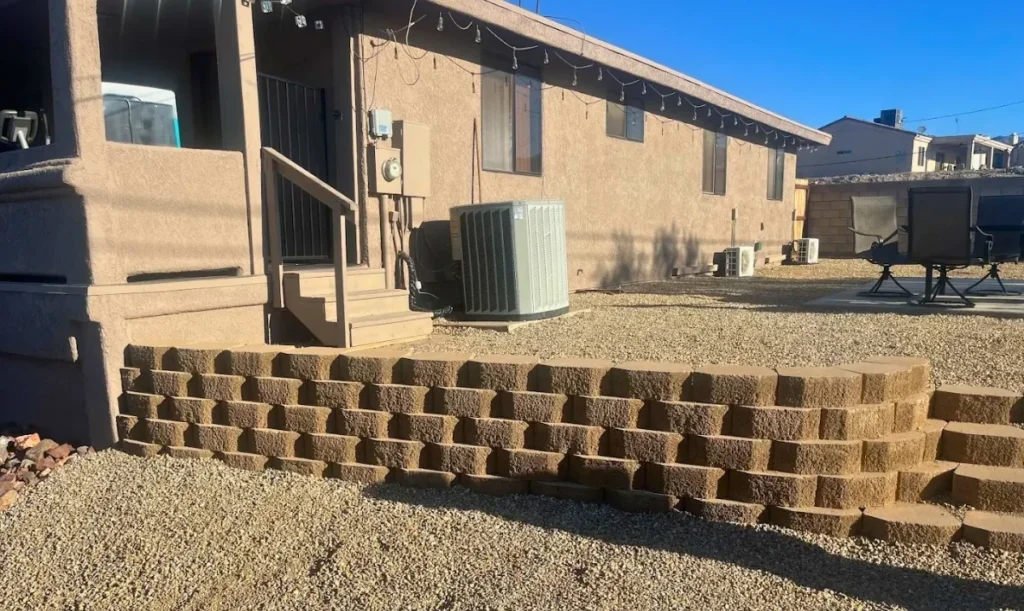
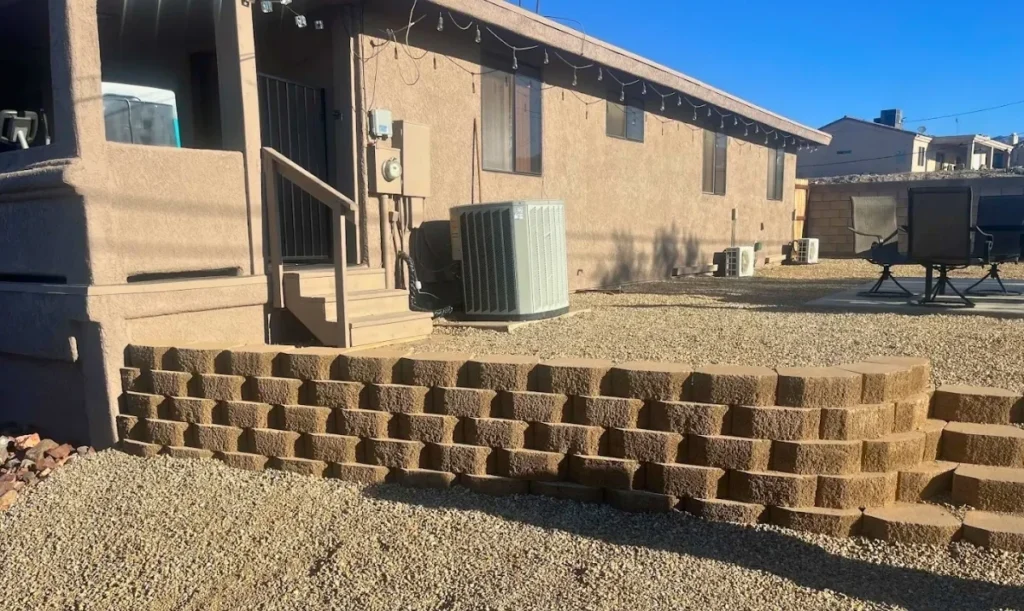
Structural solutions like rock retaining walls and terracing are the most robust ways to handle these issues. These walls act as dual-purpose structures: they create usable flat space in a yard and provide a physical barrier to stop soil migration. To ensure long-term stability, professionals include “weep holes” and gravel backfill behind the wall to prevent water pressure from building up and pushing the wall over. You can learn everything you need to know about erosion control retaining walls to understand the engineering required for these desert-durable features.
For slopes that aren’t steep enough for a wall but still suffer from erosion, “riprap”—a layer of large, irregular stones—is used to armor the soil. This is often paired with stabilized decomposed granite and deep-rooted plants like Ocotillo to create a multi-layered defense against wind and water.
Common Erosion Control Materials for Rocky Soil:
- Riprap: Large (6-12 inch) angular stones for high-flow areas.
- Boulders: Used as “anchors” to break water velocity on hillsides.
- Stabilized Decomposed Granite: A permeable surface that resists washouts.
- Geotextile Fabric: Essential for separating rock layers from native soil to prevent sinking.
Frequently asked questions about drainage solutions in rocky soil
How do professionals test for soil drainage in Lake Havasu?
Professionals perform a “perc test” by digging a hole (usually 12-18 inches deep), filling it with water, and timing how long it takes to drain. In our region, if the water hasn’t moved significantly within 30 minutes, it indicates a compaction or caliche problem. For deeper infrastructure, a soil probe or metal rod may be used to locate the depth of the hardpan layer.
What is the best rock size for desert drainage systems?
It depends on the application. For subsurface French drains, 7/8-inch angular crushed rock is the standard for its stability. For surface dry creek beds, a mix of 1.5 to 3-inch river rock is best for the channel, while 6-12 inch boulders are used for structural edges and “splash pads” at downspout outlets.
How often do rock-based drainage systems require maintenance?
While rock is low-maintenance, it isn’t “no-maintenance.” Homeowners should inspect their systems at least twice a year—ideally before and after the monsoon season. This involves clearing out fallen leaves, debris, or silt that might have settled in the rock gaps. Using a leaf blower or a rake to keep channels clear ensures that when the rain does come, the water has a clear path to follow.
Conclusion
Managing water in a desert environment is a unique challenge that requires a combination of engineering and artistry. Whether you are dealing with a soggy low spot that won’t dry out or a hillside that washes away every July, professional drainage solutions for rocky soil are the key to protecting your home’s foundation and enhancing its curb appeal.
River Palm Landscaping has been a licensed contractor in Lake Havasu City, Golden Shores, and Parker, AZ since 2003. They understand that every property has its own “rocky” personality, and a one-size-fits-all approach simply doesn’t work here. By investing in professional installation—from subsurface French drains to beautifully engineered dry creek beds—you are ensuring the long-term value and usability of your outdoor space.
If you are ready to stop worrying about the next storm and start enjoying a yard that works with the desert rather than against it, it’s time to consult with local experts who know the terrain. For more insights on stabilizing your property, check out everything you need to know about erosion control retaining walls and discover how professional hardscaping can solve your toughest yard problems.