Is Your Desert Irrigation System Actually Working?
Efficient irrigation for desert gardens isn’t just about installing a drip system. It’s about making sure every drop reaches the roots without waste.
If your plants are struggling, your water bill is climbing, or your system keeps breaking down in the Lake Havasu heat, your irrigation system likely isn’t designed for desert conditions. Here’s what efficient desert irrigation actually looks like:
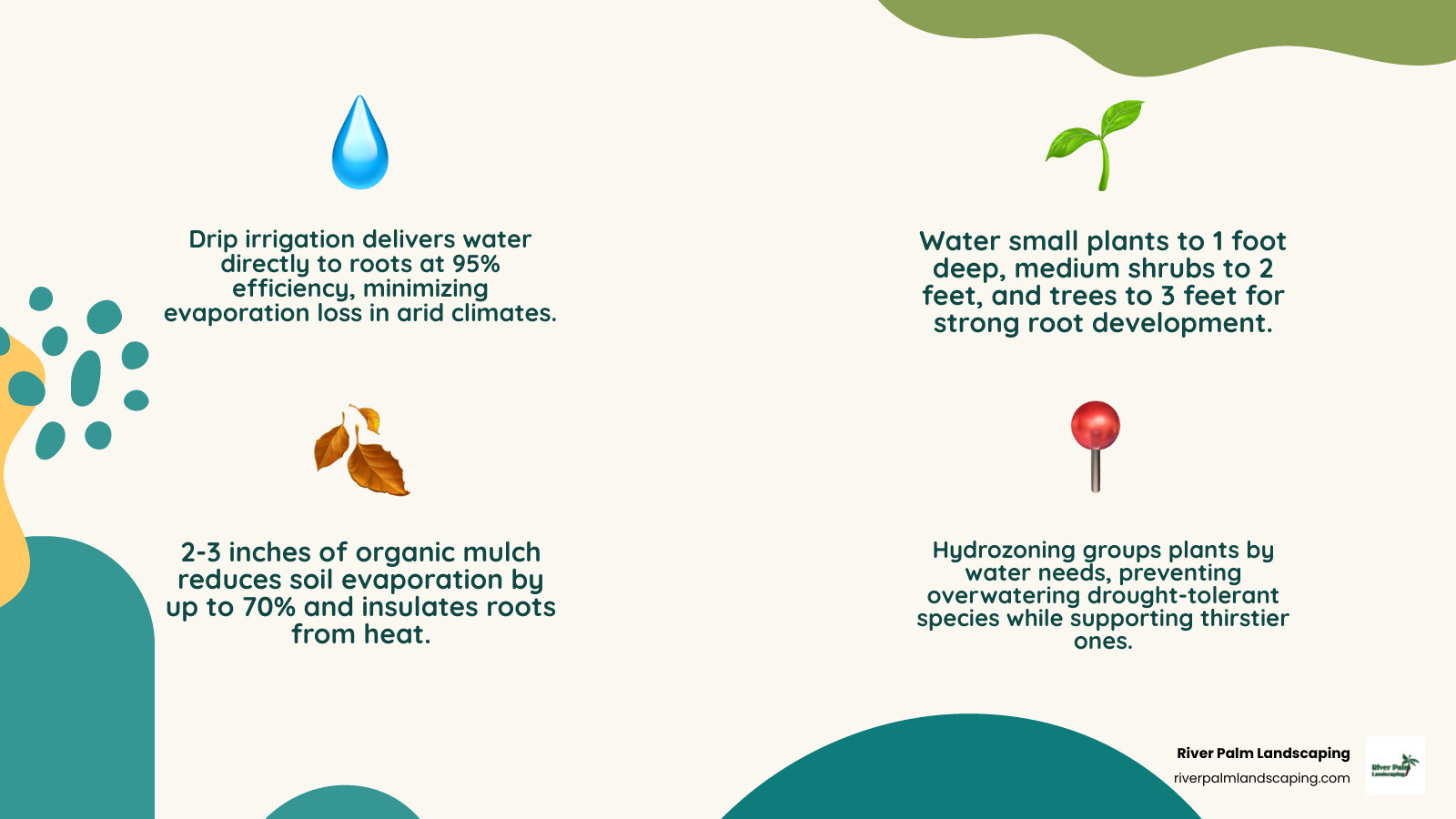
- Use drip irrigation — it delivers water directly to plant roots at up to 95% efficiency, compared to far lower rates with spray or sprinkler systems
- Zone plants by water need (hydrozoning) — drought-tolerant plants like Lantana don’t need the same schedule as young fruit trees
- Water deeply and infrequently — small plants need at least 1 foot of penetration, medium shrubs 2 feet, and trees 3 feet
- Apply 2–3 inches of organic mulch — this slows evaporation and keeps soil moisture where roots can use it
- Use a smart controller or timer — seasonal adjustments prevent overwatering in winter and underwatering during triple-digit summers
- Inspect emitters regularly — clogged or mismatched emitters are the most common cause of plant stress in desert drip systems
Water is the most limited resource in desert communities like Lake Havasu City, Golden Shores, and Parker, AZ. Traditional outdoor landscaping can account for 70–80% of a household’s total water use — and most of that water is wasted through evaporation, runoff, or poorly designed systems.
The good news? A properly designed and maintained drip irrigation system doesn’t just save water. It keeps your plants healthier, reduces your utility costs, and eliminates the frustration of constant repairs.
But most desert irrigation problems aren’t caused by the desert — they’re caused by systems that were never set up correctly in the first place.
This guide walks you through how to fix that, from the ground up.
Similar topics to efficient desert irrigation systems:
Why Efficient Irrigation for Desert Gardens is Non-Negotiable
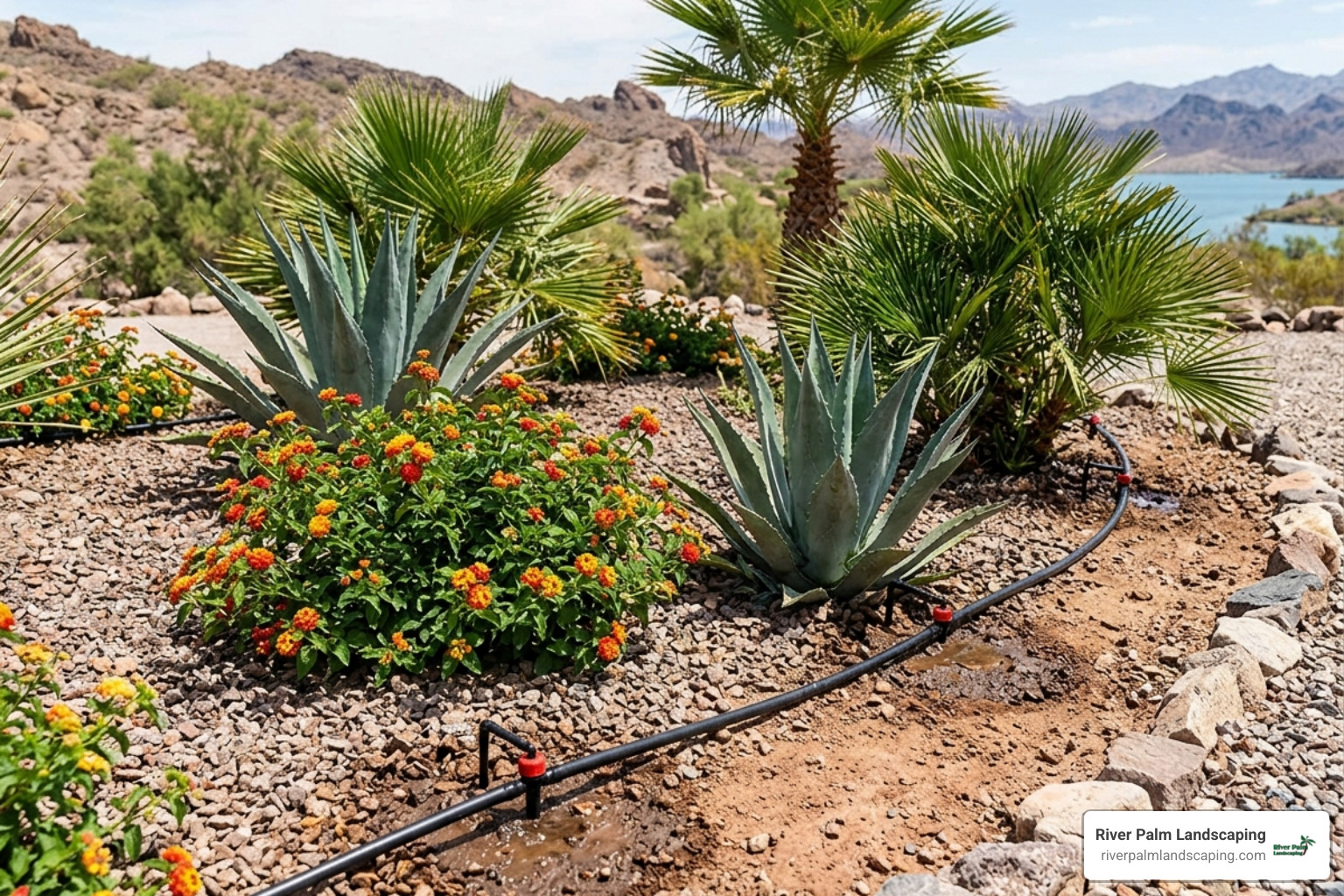
In the Mojave and Sonoran deserts, water management isn’t just a hobby; it’s a survival strategy for your landscape. Efficient desert irrigation systems rely on precision. Unlike traditional sprinklers that lose a massive percentage of water to the wind and the blazing Arizona sun, drip irrigation is roughly 95% efficient.
When water is sprayed into the air in Lake Havasu, much of it evaporates before it ever touches the soil. Even worse, water hitting the foliage of desert plants can lead to leaf burn or fungal issues. By delivering water directly to the root zone, you bypass these problems entirely. High Efficiency Irrigation Systems for Home Gardens, Shrubs and Trees demonstrate that targeted delivery is the only way to sustain a lush look without draining the local water supply. For homeowners, this means a more resilient yard that doesn’t require constant intervention. Learn more about the foundations of desert landscaping to see how these systems fit into a broader conservation plan.
The Impact of Arid Climates on Plant Survival
The heat in Lake Havasu City can be relentless, with ground temperatures often soaring far above the air temperature. This creates extreme transpiration rates—the process where plants “sweat” moisture to stay cool. If the soil doesn’t have a deep reservoir of moisture, the plant quickly enters heat stress.
In many cases, plants aren’t dying from a lack of water, but from a lack of deep water. Shallow, frequent watering encourages roots to stay near the surface, where the soil is hottest and dries out fastest. Lush & Efficient – Revised Edition emphasizes that the goal of desert irrigation is to mimic infrequent but deep desert rains, training roots to grow deep into the cooler earth.
Financial Benefits of Water-Conscious Design
Investing in a high-efficiency system pays off in more than just green leaves. High utility bills are a common complaint in Arizona, but a well-designed drip system can cut outdoor water use by up to 50%. Furthermore, you save significantly on plant replacement costs. Desert-adapted plants are an investment, and losing a mature tree to a broken irrigation line is an expensive setback. By Maximizing Your Landscape with Desert Landscaping, you increase your property’s curb appeal and functionality while keeping long-term maintenance costs manageable.
Designing a High-Performance Drip System for Arid Climates
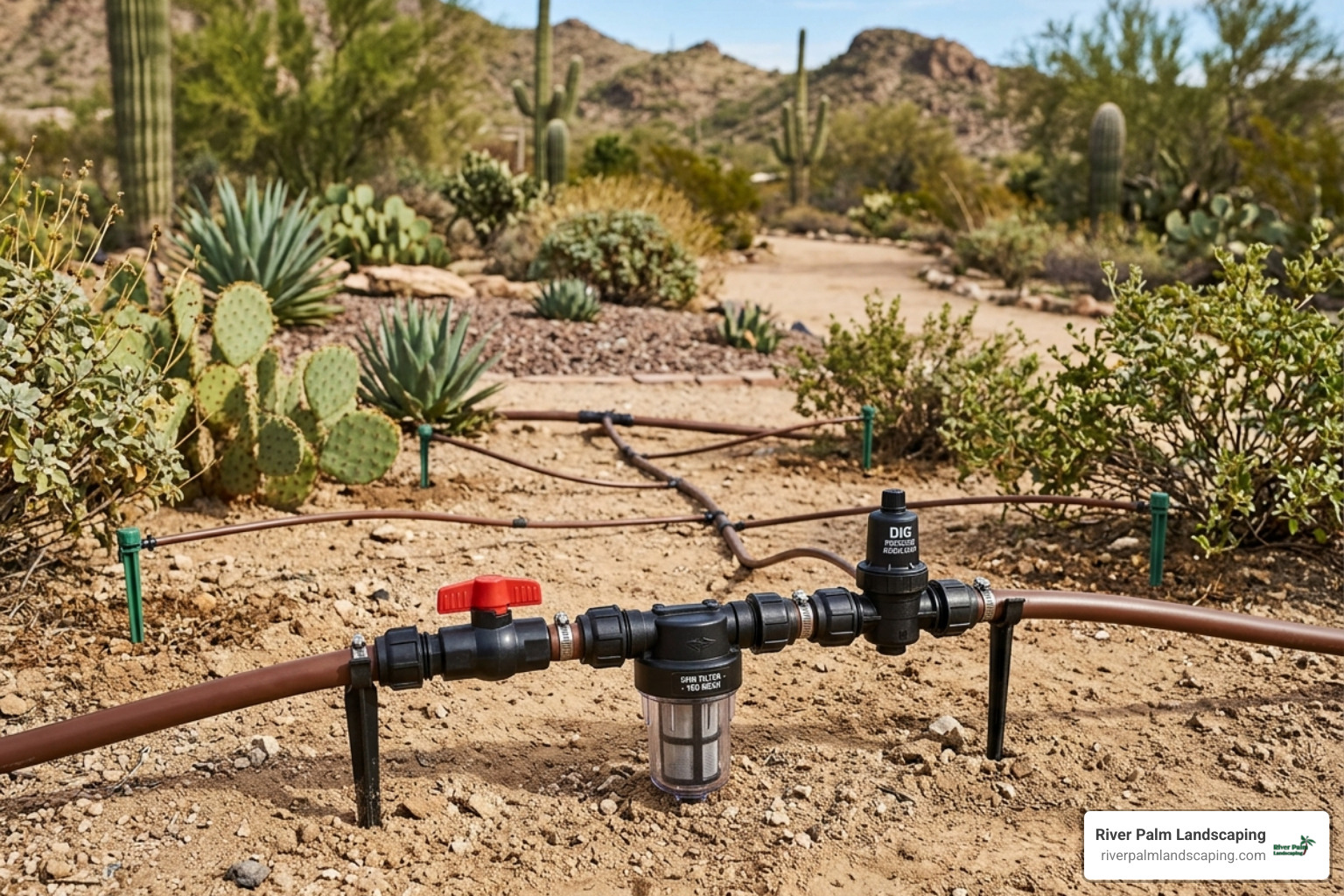
A “broken” system often isn’t actually snapped in half—it’s simply poorly designed. This is one of the most common issues we see in irrigation systems across Lake Havasu, Golden Shores, and Parker. A high-performance system for efficient desert irrigation systems requires several key components to handle our unique local conditions.
First, you must have a pressure regulator. Most residential water lines deliver water at a much higher pressure than a drip system can handle. Without a regulator keeping the pressure between 20-40 PSI, your emitters will pop off or mist, leading to massive water waste. Second, a filter is essential. Desert water often contains minerals and sediment that can easily clog tiny emitter openings. Finally, a backflow preventer ensures that irrigation water (which may contain soil bacteria or fertilizers) never flows back into your home’s clean drinking water. Following 9 Smart Desert Irrigation Design Principles Guide ensures your system is built to last. For a professional layout that considers your yard’s specific topography, professional Landscape Design is always a wise starting point.
Selecting the Right Emitters and Piping
Not all emitters are created equal. They are rated in Gallons Per Hour (GPH), typically ranging from 0.25 to 4 GPH.
- Low-flow emitters (0.5 GPH): Best for small perennials or groundcovers.
- Medium-flow emitters (1–2 GPH): Ideal for shrubs.
- High-flow emitters (4 GPH): Used for large trees or in “basin” watering setups.
In Lake Havasu, we recommend using high-quality poly tubing for main lines and micro-tubing (spaghetti) for the final run to the plant. However, be aware that local wildlife, like rabbits and ground squirrels, sometimes chew on micro-tubing. Burying your main lines 4–6 inches deep helps protect them from both the sun’s UV rays and thirsty critters. Explore more Arizona Landscape Ideas for a Cool Yard in a Hot State to see how to hide these components beautifully.
Zoning and Hydrozoning Strategies
One of the biggest mistakes in desert gardening is putting a cactus and a citrus tree on the same watering line. This is where hydrozoning comes in. Hydrozoning is the practice of grouping plants with similar water requirements into the same “zone” or valve.
A typical Lake Havasu yard might have three zones:
- Xeric Zone: Native cacti and succulents that need very little water once established.
- Desert-Adapted Zone: Shrubs like Lantana or Sage that need moderate, regular deep watering.
- High-Water Zone: Fruit trees or small patches of turf that require frequent hydration.
By separating these, you avoid drowning your desert natives while trying to keep your trees alive. This is a hallmark of smart Front Yard Landscaping Desert Homes Lake Havasu owners use to keep their curb appeal high and their water waste low.
Implementing the 1-2-3 Rule for Efficient Irrigation in Desert Gardens
To simplify desert watering, experts use the 1-2-3 Rule. This rule dictates how deep the water should penetrate the soil based on the type of plant.
| Plant Type | Watering Depth | Frequency (Summer) | Frequency (Winter) |
|---|---|---|---|
| Small Plants/Groundcover | 1 Foot | Every 2-3 days | Every 10-14 days |
| Medium Shrubs | 2 Feet | Every 4-6 days | Every 14-21 days |
| Trees | 3 Feet | Every 7-10 days | Every 21-30 days |
This strategy ensures that the entire root ball is saturated, encouraging the deep root growth necessary for survival during heatwaves. Beyond Drip Irrigation: Smart Watering Strategies for Arizona Gardens highlights that deep watering is the secret to making plants “drought-proof.”
Watering Depths for Different Plant Sizes
Why the different depths? A tree’s root system is significantly larger and deeper than a wildflower’s. If you only water a tree to a 1-foot depth, the majority of its active roots remain thirsty. You can check your watering depth by pushing a screwdriver or a soil probe into the ground about an hour after watering. It will slide easily through wet soil and stop when it hits the dry “hardpan.” If it stops at 6 inches for a tree, you need to increase your run time.
Targeting the Dripline for Maximum Absorption
As a plant grows, its most active water-absorbing roots move away from the trunk. The “dripline” is the area directly under the outer edge of the plant’s canopy. This is where your emitters should be located.
For a young tree, you might start with two emitters near the trunk. As it matures, you should move those emitters further out and potentially add more. Watering only at the base of a mature tree can actually lead to trunk rot while leaving the outer roots dry. Selecting The Best Low-Maintenance Desert Plants makes this process easier, as many of these species are more forgiving of emitter placement.
Advanced Water Conservation: Mulching, Tech, and Soil
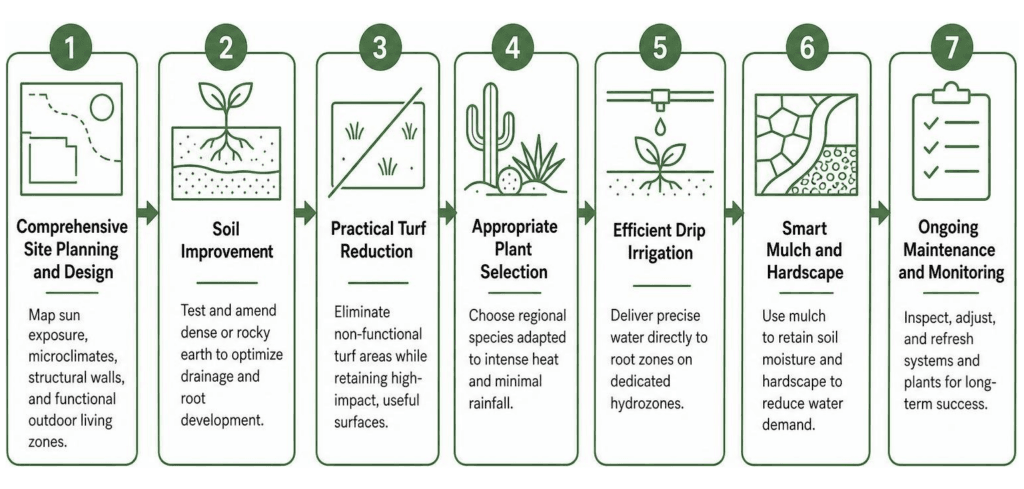
Irrigation hardware is only half the battle. To achieve truly drip irrigation systems in desert climates, you must manage the environment around the roots.
Mulching is your best friend in the desert. A 2–3 inch layer of organic mulch (like wood chips or bark) or inorganic mulch (like decomposed granite) acts as insulation. It keeps the soil temperature down and significantly slows evaporation. For most desert plants, organic mulch is preferred as it improves soil quality over time, though cacti and succulents often do better with rock mulch to prevent moisture from sitting against their stems. Desert Landscaping | Desert Water Agency notes that mulching can reduce the need for supplemental watering by keeping the moisture locked in the ground longer.
Smart Controllers and Soil Moisture Sensors
The days of “set it and forget it” timers are over. Modern smart controllers use Wi-Fi to pull local weather data. If a monsoon storm rolls through Lake Havasu and drops half an inch of rain, a smart controller will automatically skip the next scheduled watering.
Soil moisture sensors take this a step further by measuring exactly how much water is in the ground. If the soil is still moist at a 2-foot depth, the system won’t turn on. This level of automation can save thousands of gallons of water per year and ensures your plants are never overstressed or overwatered.
Soil Preparation in Rocky Desert Environments
Lake Havasu is known for rocky, sandy soil that drains almost instantly. While good drainage is important to prevent root rot, soil that drains too fast doesn’t give plants enough time to drink.
Before planting, it’s helpful to perform a “jar test” to understand your soil texture. Fill a glass jar halfway with soil, add water, shake it up, and let it settle for 24 hours. You’ll see layers of sand, silt, and clay. Most desert gardens benefit from adding organic amendments (like compost) to sandy soils to help hold onto moisture and nutrients.
Troubleshooting and Maintaining Your Desert Irrigation System
Even the best system needs a check-up. In our climate, the high mineral content of the water can lead to salt buildup and clogged emitters.
At least once a month, turn your system on and walk the yard. Look for:
- Salt crusting: White, crusty deposits on emitters.
- Dry spots: Plants that look “bedraggled” compared to their neighbors.
- Wet spots: Bubbling water or overly muddy soil, which indicates a cracked line or a popped emitter.
- Animal damage: Chewed lines or moved emitters.
Seasonal Adjustments for Lake Havasu Extremes
Your watering schedule should change at least four times a year.
- Summer (May–September): Frequent, deep watering. During extreme heat waves (108°F+), you may even need a short supplemental cycle in the early morning.
- Winter (December–February): Many desert plants go dormant. Cacti may need no water at all during these months, and trees can often go 3-4 weeks between waterings.
- Monsoon Season: Be ready to shut the system off manually if we get significant rainfall.
Common Mistakes in Efficient Irrigation for Desert Gardens
The most common mistake is overwatering. People see a wilting plant and assume it needs water. However, in the desert, overwatering in heavy soil can cause root rot, which prevents the plant from taking up water—causing it to wilt. It’s a vicious cycle.
Other mistakes include:
- Mismatched emitters: Mixing different GPH emitters on the same line without a plan.
- Shallow watering: Watering for 10 minutes every day instead of 2 hours once a week.
- Poor filtration: Skipping the filter and allowing the tiny holes in the drip line to clog with sand.
As noted in Irrigation tips for desert gardens – Arizona Daily Star, consistency and depth are far more important than frequency.
Frequently Asked Questions about Efficient Irrigation in Desert Gardens
How often should I check my drip system for leaks?
You should do a visual inspection once a month. However, you should also keep an eye on your water bill. A sudden, unexplained spike in your monthly statement is often the first sign of an underground leak in a desert irrigation system.
Can I use greywater or rainwater for my desert garden?
Absolutely. Rainwater harvesting (using swales or barrels) is an excellent way to supplement your irrigation and help flush accumulated salts out of the soil. Greywater (from showers or laundry) can also be used, but it requires a specialized setup to ensure it doesn’t clog your drip emitters or harm sensitive plants.
Why are my desert plants dying despite regular watering?
It is likely one of two things: either you are watering frequently but too shallowly (not reaching the roots), or you are overwatering and have caused root rot. Use a soil probe to check the moisture depth. If the soil is soaking wet but the plant is dying, stop watering and let it dry out.
Conclusion
Creating a thriving, water-efficient garden in the desert doesn’t have to be a struggle against nature. By focusing on efficient irrigation desert gardens need—specifically through smart design, hydrozoning, and the 1-2-3 rule—you can enjoy a beautiful outdoor space that stands up to the Arizona heat.
At River Palm Landscaping, we’ve spent over 20 years helping homeowners in Lake Havasu City, Golden Shores, and Parker, AZ, build durable, climate-appropriate landscapes. From full system installations to retrofitting older yards with smart technology, we specialize in solutions built for rocky soil and extreme temperatures. A well-installed irrigation system is an investment in your home’s usability, curb appeal, and long-term value.
If your irrigation system isn’t working the way it should, the problem is usually design, not the desert. River Palm Landscaping installs and upgrades desert irrigation systems built specifically for rocky soil, extreme heat, and water efficiency. Start your project with professional Desert Landscaping today.