Why Retaining Wall Drainage Solutions Protect Your Investment from the Ground Up
Retaining wall drainage solutions are the difference between a wall that lasts decades and one that fails within a few years. If you need a quick answer, here are the core components every properly drained retaining wall should have:
- Drainage aggregate — at least 12 inches of clean, angular gravel (¾” crushed stone or #57 washed stone) directly behind the wall
- Perforated drain pipe — 4-inch diameter pipe at the base of the drainage zone, sloped at minimum 1–2% toward a discharge outlet
- Non-woven geotextile fabric — wrapped around the drainage stone to prevent soil fines from clogging the system
- Weep holes — spaced every 6–10 feet along the base course to relieve pressure if the pipe becomes overwhelmed
- Proper outlet — the drain pipe must daylight to an open area, swale, or storm drain where water can exit freely
Retaining walls in Lake Havasu City face conditions that most drainage guides simply don’t account for. Caliche-heavy soil, intense monsoon storms, and the freeze-thaw extremes of the high desert can all push water behind a wall faster than a poorly designed system can handle it.
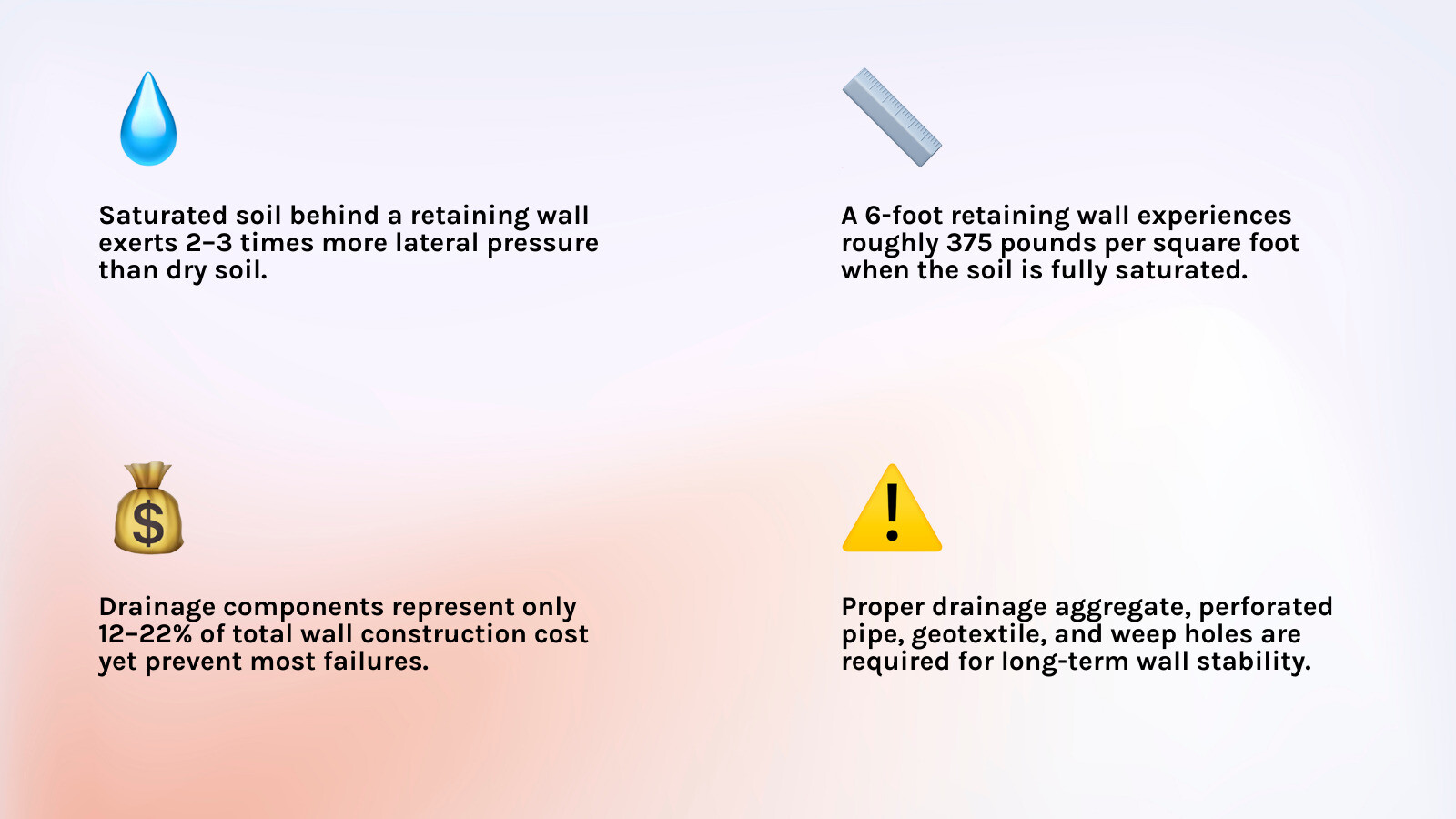
The numbers tell the story. Saturated soil behind a retaining wall can exert 2–3 times the lateral pressure of dry soil. A 6-foot wall that handles around 180 pounds per square foot of pressure when dry faces roughly 375 pounds per square foot when the soil is fully saturated. That kind of force doesn’t announce itself — it quietly builds until a wall starts to bow, lean, or collapse.
The good news is that a correctly installed drainage system prevents the vast majority of these failures. The drainage components themselves typically represent only 12–22% of a wall’s total construction cost — a fraction of the $10,000 to $25,000 or more it can cost to repair or replace a wall that fails because water had nowhere to go.
Easy retaining wall drainage solutions glossary:
The Physics of Hydrostatic Pressure: Why Retaining Wall Drainage Solutions Matter
To understand why a wall fails, you have to look at the physics of the earth behind it. Dry soil is relatively stable and exerts a predictable lateral earth pressure against the back of a wall. However, when a sudden desert downpour saturates that same soil, the water fills every microscopic pocket between the soil particles.
Because water is non-compressible and heavy (weighing 62.4 pounds per cubic foot), it creates immense hydrostatic pressure. This pressure acts like a hydraulic jack, pushing outward in all directions. If the water cannot escape, this lateral force easily exceeds the structural capacity of the block or stone. Implementing proper drainage prevents up to 80% of structural wall failures by completely neutralizing this pressure buildup. You can learn more about how these forces interact in our guide to erosion control and retaining walls.
When undrained water is trapped behind a wall, the active load can increase by 40% to 80% compared to its original design. Without a dedicated escape route, the water will find its own way out—often by pushing the top of the wall forward, blowing out individual blocks, or completely washing out the soil foundation at the base.
Core Components of an Engineered Retaining Wall Drainage System
A high-performance drainage system is not a single product; it is a unified network of components designed to intercept, collect, and discharge water before it can touch the structural face of the wall.
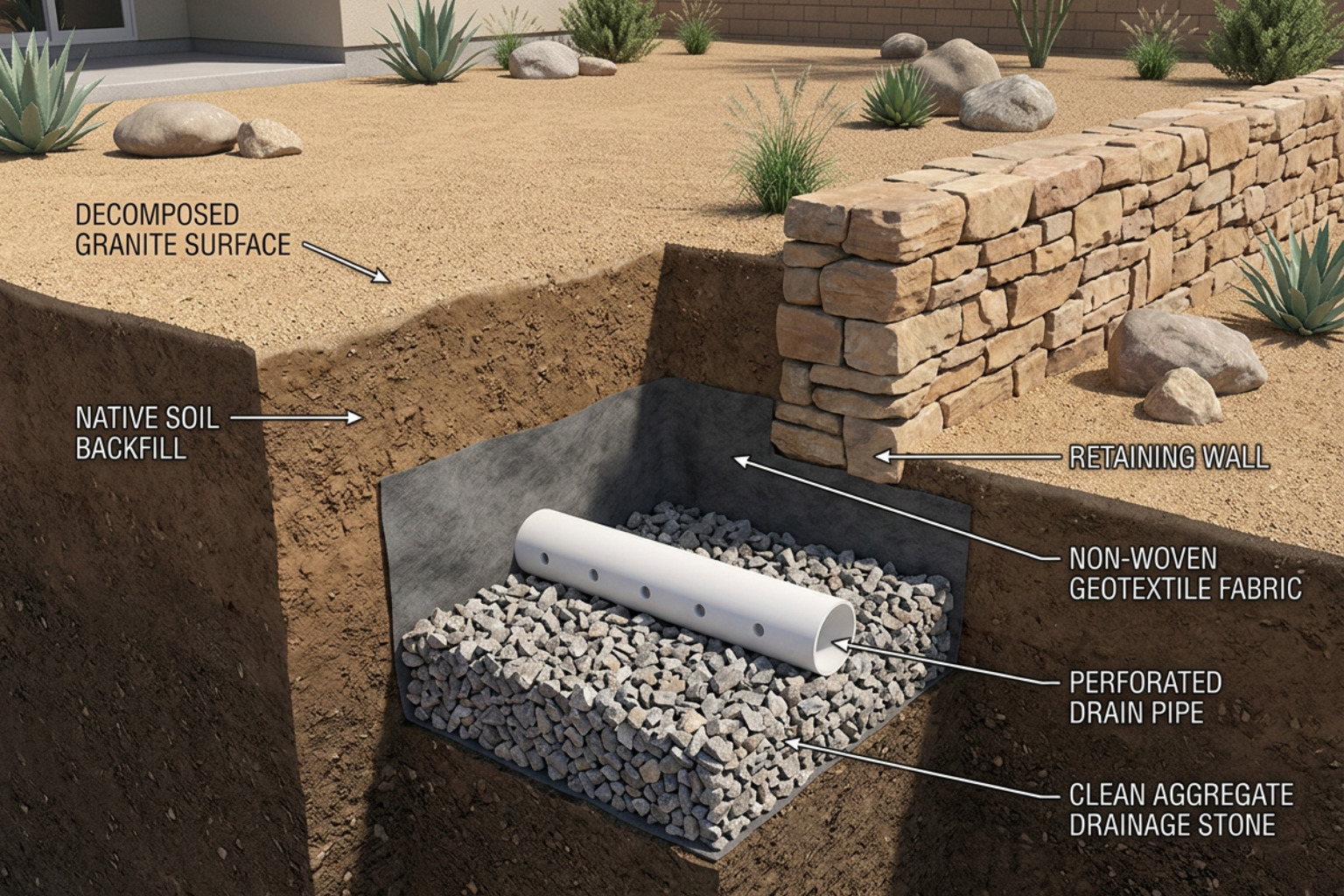
An engineered drainage system consists of several critical layers working in tandem:
- Low-Permeability Soil Cap: A 200 mm (approx. 8-inch) layer of compacted native soil or clay at the very top of the backfill zone. This sheds surface runoff away from the wall crest and prevents surface water from immediately saturating the drainage aggregate below.
- Drainage Aggregate Column: A vertical chimney of clean, open-graded stone (minimum 12 inches wide) placed directly behind the retaining wall blocks. This acts as a high-speed highway, forcing water to drop straight down to the footing rather than collecting behind the blocks.
- Non-Woven Geotextile Fabric: A synthetic filter envelope that separates the drainage aggregate from the native backfill soil. It allows water to pass through freely while stopping fine silt and clay particles from migrating into and clogging the stone column.
- Perforated Drain Pipe: A heavy-duty, perforated pipe placed at the bottom of the aggregate column to collect the falling water and route it away from the wall.
- Weep Holes: Outlets built through the front face of the wall to relieve localized pressure and act as a secondary escape route.
Perforated Pipes and Weep Holes as Core Retaining Wall Drainage Solutions
At the foundation of any reliable system is the drain pipe (often called an AG or agricultural pipe). For walls 3 feet or taller, a 4-inch perforated PVC or corrugated HDPE pipe is required. Rigid PVC is highly recommended for residential installations in the Lake Havasu region because of its resistance to crushing during the backfill compaction process. When installing rigid PVC, the perforations must face downward toward the trench floor. This allows the water table to rise naturally into the pipe from the bottom, where it is instantly carried away.
To complement the pipe, weep holes must be integrated into the wall face. These are through-facing PVC pipes (typically 2 to 4 inches in diameter) sloped downward at a 2% to 5% gradient. For smaller residential walls under 4 feet, a 1.5-inch weep hole spaced every 8 feet is generally sufficient. For taller structures, a 3-to-4-inch weep hole should be installed every 3 to 4 feet along the base of the wall.
Geotextile Filter Fabrics and Aggregate Columns
The vertical drainage stone column must be a minimum of 12 inches wide. The only acceptable material for this zone is clean, angular crushed rock, such as #57 washed stone (ranging from ½ inch to ¾ inch in size). Round pea gravel or “crusher run” (which contains fine stone dust) should never be used, as they pack together tightly and choke off water flow.
To protect this stone column over its 30+ year lifespan, it must be wrapped in a high-quality, non-woven geotextile fabric. Woven landscape fabrics (the shiny, plastic-like rolls sold at big-box home improvement stores) are designed for weed control, not drainage; they clog quickly and have poor water permeability. Non-woven geotextile is engineered specifically to filter out micro-fine soil particles while maintaining a high flow rate. If you are wondering whether your yard requires a system like this, read our detailed article on when your yard needs a french drain.
How Soil Type and Wall Height Dictate Drainage Design
One size does not fit all when it comes to retaining wall engineering. The height of your wall and the native soil conditions of your property in Lake Havasu City, Golden Shores, or Parker, AZ, are the primary drivers of drainage design.
In our local Mojave Desert region, soils generally fall into two categories: highly porous sandy gravels or dense, cement-like caliche. Caliche acts like natural concrete; it does not absorb water and forces runoff to pool rapidly. If your wall is backing into caliche or heavy clay, your drainage system must be upsized to handle the lack of natural soil permeability.
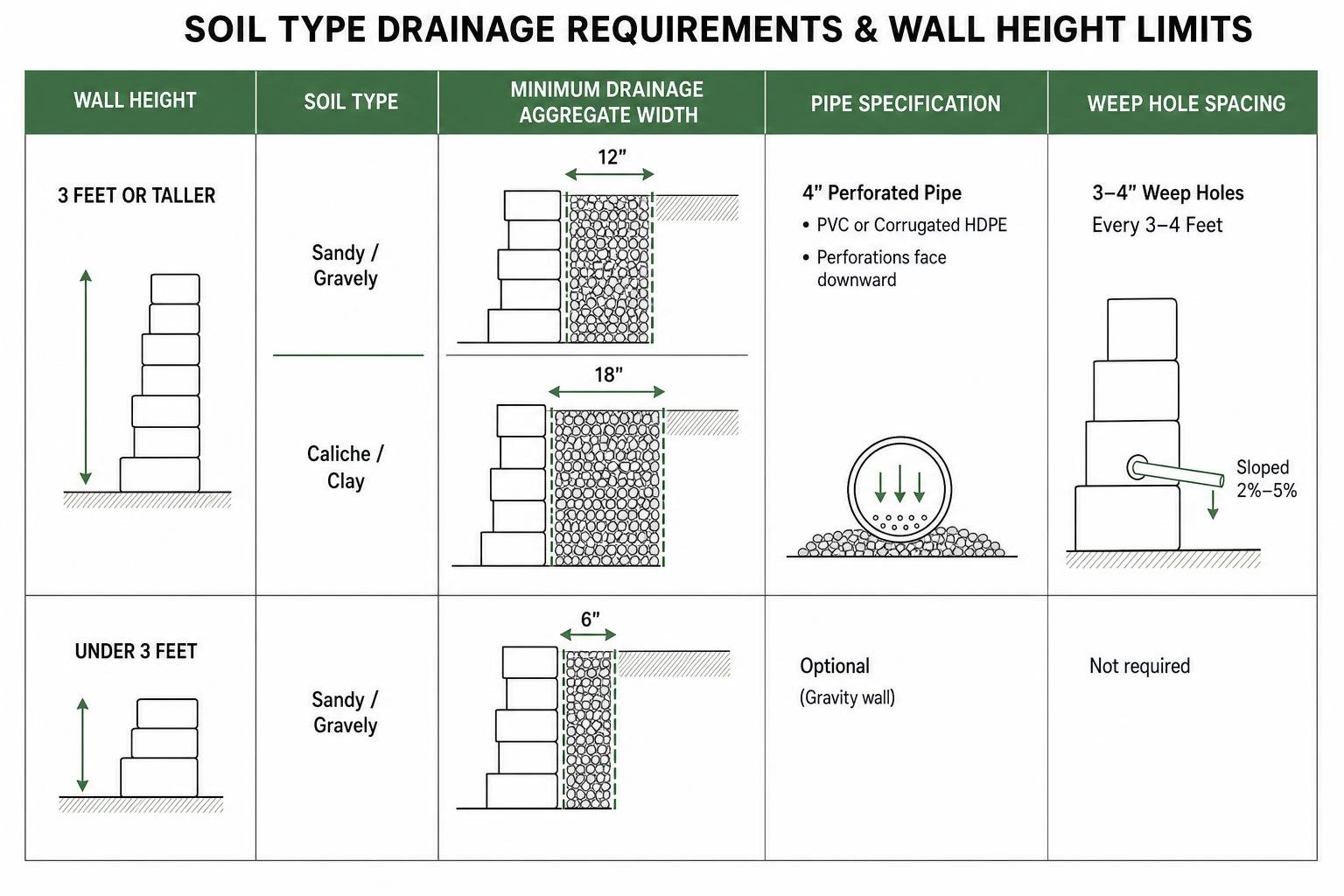
The table below outlines the minimum drainage requirements based on wall height and soil type:
| Wall Height | Soil Type | Minimum Drainage Aggregate Width | Pipe Specification | Weep Hole Spacing |
|---|---|---|---|---|
| Under 3 Feet | Sandy / Gravely | 6 inches | Optional (Gravity wall) | Not required |
| Under 3 Feet | Caliche / Clay | 12 inches | 4-inch Perforated HDPE | Every 8 feet (1.5-inch diameter) |
| 3 to 5 Feet | Sandy / Gravely | 12 inches | 4-inch Perforated PVC | Every 6 to 8 feet (2-inch diameter) |
| 3 to 5 Feet | Caliche / Clay | 18 inches | 4-inch Rigid PVC (SDR 35) | Every 4 to 6 feet (3-inch diameter) |
| Over 5 Feet | All Soils | 18 to 24 inches | Dual 4-inch PVC (Base & Mid-height) | Every 3 to 4 feet (4-inch diameter) |
For walls exceeding 3 feet in height, proper drainage is not just a recommendation—it is a structural necessity. Taller walls often require a secondary “heel drain” or a mid-height collector pipe to prevent water from cascading down the back of the wall face. For more information on building walls tailored to Arizona’s unique soil profiles, check out our Block Retaining Wall Arizona Guide.
Managing External Water Sources and Monsoon Runoff
While groundwater is a constant force, external water sources represent the greatest threat of sudden wall failure in Arizona. Our winter rains and summer monsoons deliver massive volumes of water in incredibly short periods. If your home’s roof downspouts, patio drains, or pool overflow lines discharge near the top of your retaining wall, the system will quickly become overwhelmed.
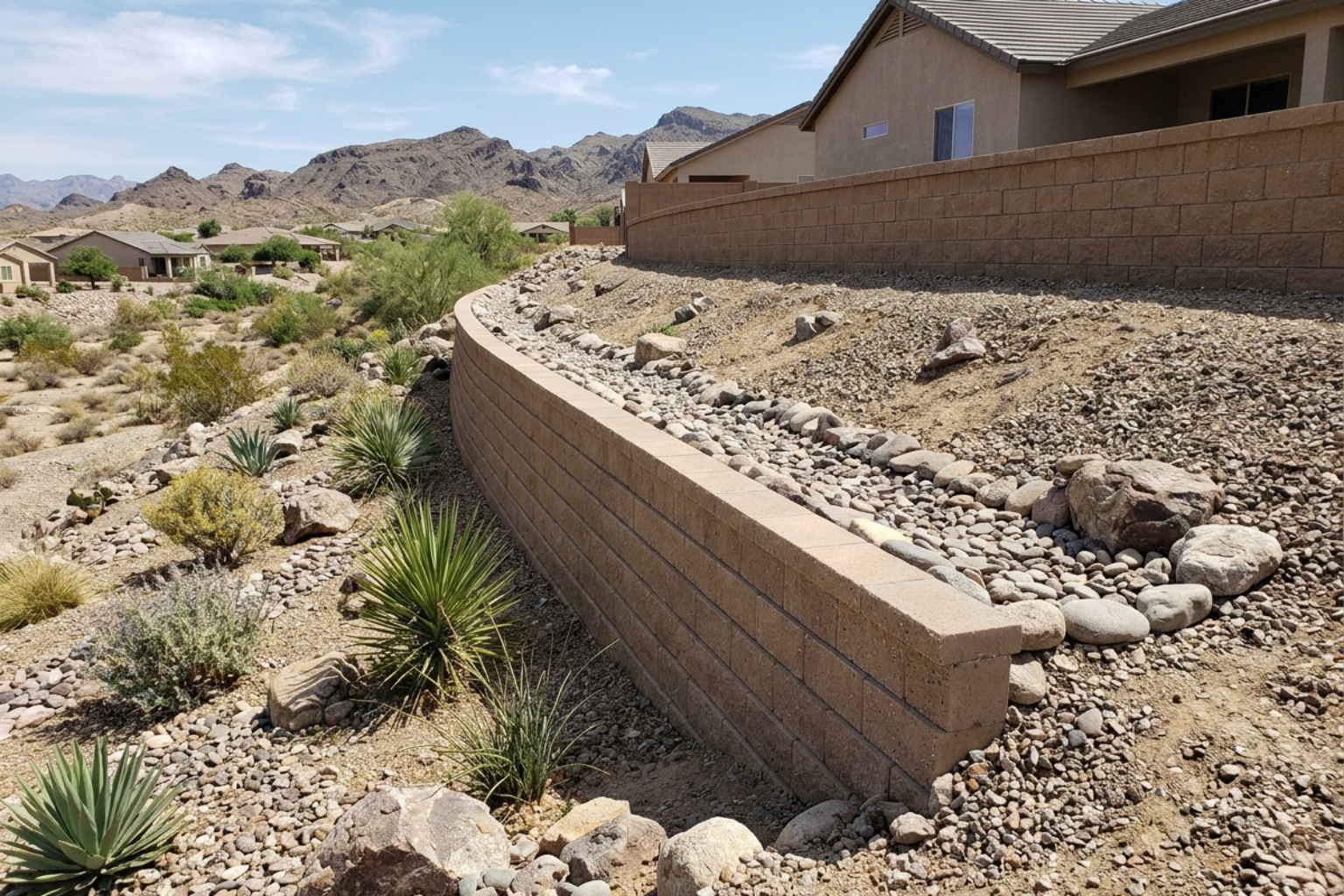
To prevent this, concentrated water sources must be piped completely away from the retaining wall zone using solid (non-perforated) PVC pipes. Additionally, the ground surface at the top of the wall must be graded to slope away from the wall crest at a minimum 2% decline for at least 10 feet. If the natural slope of your yard forces water toward the wall, a shallow, rock-lined drainage swale should be constructed to intercept the surface runoff and channel it safely around the sides of the wall structure. For homeowners dealing with sloped yards and hard desert dirt, our guide on Drainage Solutions for Rocky Soil provides practical, step-by-step diversion strategies.
Common Installation Mistakes and How to Avoid Them
Even with the highest quality materials, minor installation errors can lead to catastrophic failures. Here are the most common mistakes local homeowners and inexperienced builders make:
- Using “Crusher Run” or Pea Gravel: Crusher run contains fine stone dust that mixes with water to form a dense, impermeable barrier. Pea gravel is too round and rolls easily, failing to provide structural support behind the wall blocks. Always specify clean, angular #57 washed stone.
- Skipping the Filter Fabric: Omitting the non-woven geotextile fabric saves a few dollars upfront but allows native soil to wash into the drainage stone. Within two seasons, the stone column becomes packed with dirt, completely choking the system.
- Improper Soil Compaction: When backfilling the native soil behind the drainage zone, the soil must be compacted in thin 6-inch lifts using a mechanical tamper. Uncompacted soil will settle over time, creating low spots at the surface where water will pool and saturate the wall.
- Tying Roof Downspouts into the Wall Drain: Never connect high-volume roof gutters or surface catch basins directly into the perforated pipe behind your wall. This forces thousands of gallons of water directly into the backfill soil, causing immediate failure. Keep your surface drainage and wall drainage completely separate.
To understand how proper construction techniques prevent these issues from happening in the first place, read about the best retaining wall for slope management and stability.
Retrofitting Existing Structures with Modern Retaining Wall Drainage Solutions
If you have an existing retaining wall that is showing signs of distress—such as bowing outward, tilting forward, or displaying white, powdery stains (efflorescence) on the block face—it is likely suffering from drainage failure. Efflorescence is caused by mineral-rich water soaking through the concrete blocks and evaporating, leaving salt deposits behind.
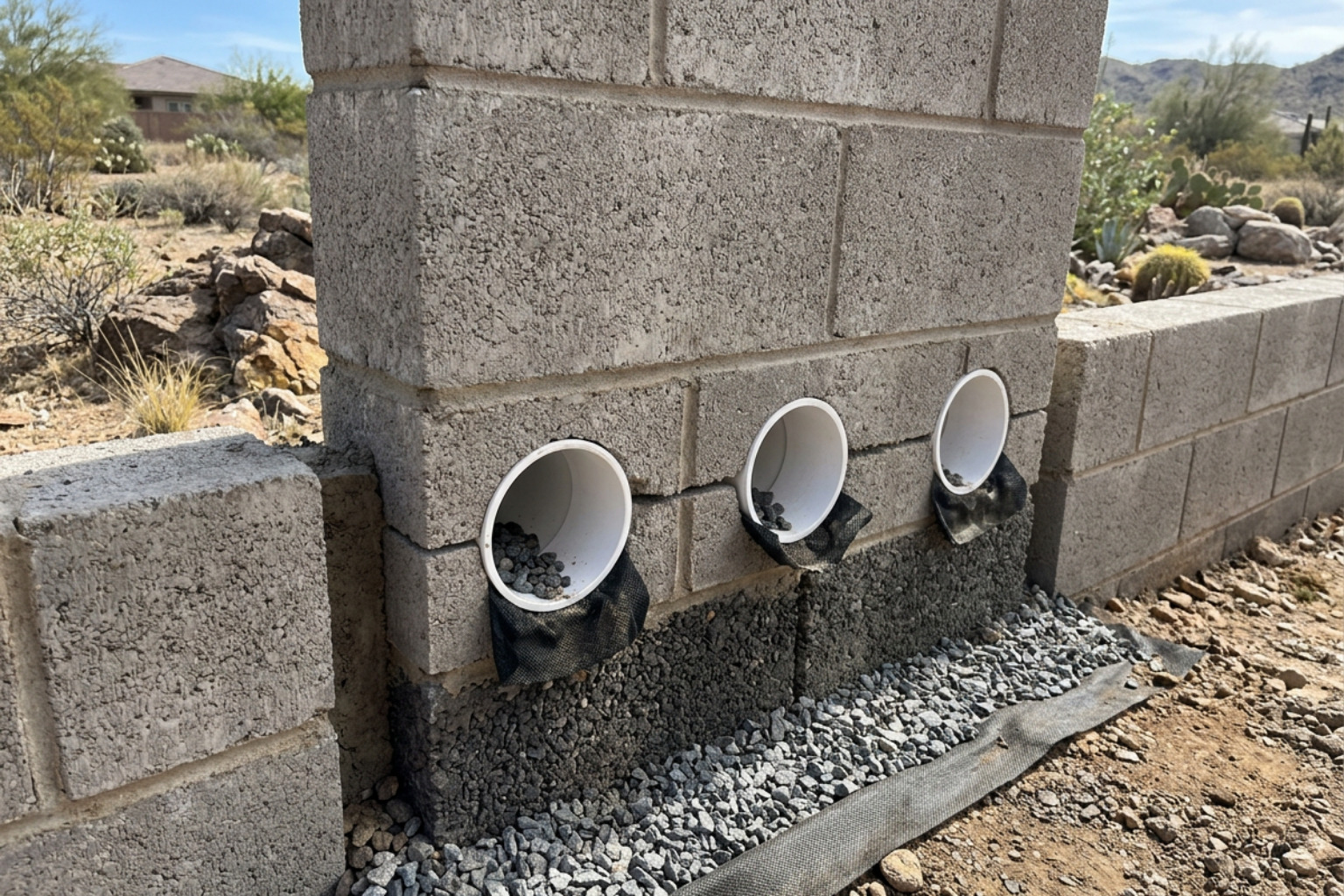
Fortunately, you don’t always have to tear down the wall to fix it. Modern retrofitting techniques can relieve trapped pressure:
- Core-Drilled Weep Holes: Using a heavy-duty diamond core drill, we can cut 3-inch holes through the bottom course of the wall. Inserting a PVC sleeve wrapped in a geotextile filter sock allows trapped water to escape directly through the face.
- Relief Trenches: If the space behind the wall is accessible, we can excavate a narrow 12-inch trench down to the footing, install a perforated pipe, wrap it in geotextile, and backfill with washed stone.
- Adding a Drainage Mat: In tight spaces where aggregate cannot be easily brought in, slim geocomposite drainage mats can be installed against the back of the wall during a partial excavation to channel water downward.
Frequently Asked Questions About Retaining Wall Drainage
Do short retaining walls under 3 feet need drainage?
Yes. While gravity walls under 3 feet built in highly sandy desert soils can sometimes get by without a complex pipe network, clay-heavy soils or areas near active irrigation systems always require drainage. Even a 2-foot wall can bow and crack if the soil behind it becomes a muddy, heavy slurry.
Can I use standard landscape fabric instead of non-woven geotextile?
No. Standard woven landscape fabric is designed to block weeds while letting minimal water through. It has a tight weave that easily clogs with clay and silt fines, rendering your drainage system useless within a year or two. Non-woven geotextile is engineered specifically for sub-surface water filtration and will not clog.
How do I clear a clogged retaining wall drain pipe?
To keep your system running smoothly, we recommend flushing the drain pipes annually before the summer monsoon season. Insert a garden hose or a high-pressure sewer jetter nozzle into the daylighted outlet of your drain pipe to wash out any accumulated silt or desert pests. Installing a protective slotted end cap or wire rodent guard on all daylighted outlets will prevent small animals from nesting inside and blocking the water flow.
Conclusion
A beautiful retaining wall can transform a sloped desert yard into a functional, multi-tiered outdoor living space, but its beauty is only as deep as its drainage system. Skipping out on proper aggregate, filter fabric, or perforated piping is a gamble that rarely pays off when the desert monsoons arrive.
If you are planning a new hardscape project or need to rescue a bowing wall on your property, work with an experienced, licensed local contractor who understands the unique engineering challenges of our region. At River Palm Landscaping, we have been building durable, climate-appropriate retaining walls and custom drainage systems for homeowners in Lake Havasu City, Golden Shores, and Parker, AZ, since 2003.
Ready to secure your property with a professionally engineered retaining wall? Contact our local team today for an expert consultation on https://riverpalmlandscaping.com/erosion-control-retaining-walls/.